This is the anniversary of my starting to blog.
I started this blog to do posts to the accrectionary wedge. Since that blog has stopped, I've stopped using this blog. I keep on hoping another geology blog will start up where geologist can participate and I could contribute to it. I haven't come across anything yet. If you know of something let me know. Till then take care.
Wednesday, October 5, 2016

Thursday, August 7, 2014
Thoughts about marrying a geologist
I saw this at Letter to Ann Landers about marrying geologist at one of my favorite blogs to read En Tequila Es Verde. I really liked it a lot and am including it here (this is the link that I saw it at).
Great pictures of calcite
Site for Northwest Field books
I like to follow Northwest geology. They've listed some books and I
don't want to loose track of them so here they are
http://nwgeology.wordpress.com/2012/03/01/new-geology-books/ . and
now for the link . Now if I just had some time to read them.
I was reading northwest geology and came across this Finding geologic information file for finding geologic public information.
I was reading northwest geology and came across this Finding geologic information file for finding geologic public information.
List of famous Rocks
I was looking for information on Gibraltar and came across this list of
famous Rocks and it got my attentions so here's Wikipedia famous List_of_famous_rocks. Now I see a meme coming.
Metamorphic facies illustration & QAPF Diagram
I always love this illustration. It has so much information to it. I
didn't know where I could find it again but Dana has used it for her
Accretionary Wedge 43 and now I'm copying it here here so I can have a reference to it.
They can also be hilarious. Observe:

Note
the upper left. One of my geo friends on Twitter posted this ages ago
(I wish I remembered who), and it still makes me giggle.
Thanks Dana for sharing and using this.
3-1-12 I also came across this QAPF on igneous rocks @ Sandatlas and have found this very helpful too.
Here it is, the classification diagram used for plutonic rocks:

QAPF diagram for plutonic rocks. The diagram was created by the Subcommission of the Systematics of Igneous Rocks in the latter part of the 20th century.
old
Few explaining words how to read
this diagram. There are four minerals or mineral groups chosen as
important cornerstones of the classification. These are quartz (Q),
alkali feldspars (A), plagioclase feldspars (P), and feldspathoids (F).
F and Q for chemical reasons can not exist together in one plutonic
rock. Other minerals may and almost certainly occur in these rocks as
well but they have no significance in this classification scheme. So,
the whole diagram is actually composed of two ternary plots (QAP and
FAP). To use the classification, the concentration (the mode) of these
minerals must be known and recalculated to make their sum 100%.
Example: a plutonic rock that contains no alkali feldspar and no feldspathoids but contains lots of pyroxenes (neglected in this diagram), plagioclase feldspar and few quartz grains is probably gabbro (located at the right edge of the diagram, little bit up from P towards Q). The diagram doesn’t say whether it is gabbro, diorite, or anorthosite. There are another criteria used to decide that. Note that this diagram is not used for all plutonic rocks. Ultramafic rocks are the most important plutonics that have separate classification diagrams.
Here's the QAPF_diagram link to it at Wikipedia
http://en.wikipedia.org/wiki/QAPF_diagram
I did have this at a different location since this is more appropriate for it I've moved it here.
They can also be hilarious. Observe:

Metamorphic facies diagram from The Science Education Resource Center at Carleton College*
Thanks Dana for sharing and using this.
3-1-12 I also came across this QAPF on igneous rocks @ Sandatlas and have found this very helpful too.
Here it is, the classification diagram used for plutonic rocks:

QAPF diagram for plutonic rocks. The diagram was created by the Subcommission of the Systematics of Igneous Rocks in the latter part of the 20th century.
old
QAPF
diagram for plutonic rocks. The diagram was created by the
Subcommission of the Systematics of Igneous Rocks in the latter part of
the 20th century.
Example: a plutonic rock that contains no alkali feldspar and no feldspathoids but contains lots of pyroxenes (neglected in this diagram), plagioclase feldspar and few quartz grains is probably gabbro (located at the right edge of the diagram, little bit up from P towards Q). The diagram doesn’t say whether it is gabbro, diorite, or anorthosite. There are another criteria used to decide that. Note that this diagram is not used for all plutonic rocks. Ultramafic rocks are the most important plutonics that have separate classification diagrams.
Here's the QAPF_diagram link to it at Wikipedia
http://en.wikipedia.org/wiki/QAPF_diagram
I did have this at a different location since this is more appropriate for it I've moved it here.
Monday, August 4, 2014
Geologic Concept: Natural Gas Seep
NATURAL GAS SEEP
Natural Gas seeps occur when there is a fissure in the rock and natural gas can escape. The definition for gas (Dictionary of Geological Terms- Revised Edition by American Geological Institute (1976) pg 178) is: Naturally occurring gaseous hydrocarbon produced in association with petroleum or as marsh gas.
I went to the Eternal Flame Falls and thought this was a great example of that.

Natural Gas seeps occur when there is a fissure in the rock and natural gas can escape. The definition for gas (Dictionary of Geological Terms- Revised Edition by American Geological Institute (1976) pg 178) is: Naturally occurring gaseous hydrocarbon produced in association with petroleum or as marsh gas.
I went to the Eternal Flame Falls and thought this was a great example of that.
This blog is going in a new direction with Geological Concepts.
I started this blog so I would have a place to keep track of my submissions to the Accrectionary Wedge. The Accretionary Wedge is a blog of a carnival of blogs that like to discuss different things relating to geology. Lately its been inactive so I've decided I need to figure out what I want to do with this blog. I've decided Its going to be a place were I keep track of different geological concepts that have captivated my attention for the time being. I love to travel and I've notice when I do sometimes I end up looking a lot of things up on Wikipedia and such - this blog will now help me keep it in one place.
I know I have a lot of idea's and hope I can post them on a regular basis. But I won't be like Lockwood at Outside the Interzone where its done on a daily bases. It's just when something strikes me as being interesting.
I know I have a lot of idea's and hope I can post them on a regular basis. But I won't be like Lockwood at Outside the Interzone where its done on a daily bases. It's just when something strikes me as being interesting.
Wednesday, April 16, 2014
Accretionary Wedge 64???
I'm still waiting on a call to post. Makes me wonder what's happening with it. Does anyone know what's going on with it.
Wednesday, January 22, 2014
Accretinary Wedge #64 Still waiting on the call
As best as I can tell there has been no call to post yet.
http://theaccretionarywedge.wordpress.com/whos-hosting-the-next-accretionary-wedge/
http://theaccretionarywedge.wordpress.com/whos-hosting-the-next-accretionary-wedge/
Accretionary Wedge #63
Here is where it was being hosted.
http://plantsandrocks.blogspot.com/search/label/Accretionary%20Wedge%20blog%20carnival
Do to things going on in my life I chose not to participate in this one.
http://plantsandrocks.blogspot.com/search/label/Accretionary%20Wedge%20blog%20carnival
Do to things going on in my life I chose not to participate in this one.
Monday, October 28, 2013
Accretionary Wedge #62- Geolloween
I like to participate in the Accretionary Wedge and when I went to
check on this month call to post I realized that Novembers was out too.
The call for November Accretionary Wedge is here @ Martin B:
http://blog.martinb.za.net/2013/call-for-posts-accretionary-wedge-geolloween-edition/
In the absence of anyone more suitable, I am going to be hosting the November Accretionary Wedge.
It being November’s, it will be Hallowe’en themed, or much more
appropriately, Geollowe’en (which works pretty well with my accent at
least). So, keep an eye out for the geological pumpkins, rock candy
(that is a thing, right?) and trick and treating trilobites in order to
share them here.This call for posts is a bit early, in order to allow people to keep
an eye out in a few weeks. Deadline to be around 14 November-ish?I am not really sure that I will have much to post myself, since
South Africa does not do the whole Hallowe’en thing in any sort of
seriousness, let alone Geollowe’en, but I look forward to what other
people have spotted.
Comments are open on this post.
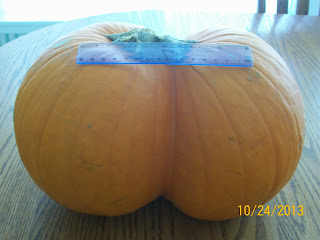
I have three pumpkins that I'd like to submit.
The first one when you look at it from one angle it looks like an ordinary pumpkin

But when you look at it from a different angle you can see that its a conjoined twin.
It reminded me of twinning in some feldspar crystals.

After I took the photo's I realized I would be remiss not to have a scale on it so you can get a sense of how big they were.
 Next one is:
It reminded me of pillow lava.
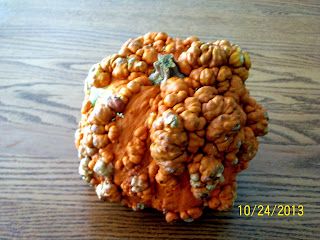 Again
I forgot to use the scale and this didn't quite turen out how I wanted
it to and you can barely see the scale but it is there.
Again
I forgot to use the scale and this didn't quite turen out how I wanted
it to and you can barely see the scale but it is there.
 The last one I wanted to use is this one.
 No scale but the brick are 8x4 inches long.

The call for November Accretionary Wedge is here @ Martin B:
http://blog.martinb.za.net/2013/call-for-posts-accretionary-wedge-geolloween-edition/
Call for posts – Accretionary Wedge, Geollowe’en Edition
{0 Comments}
Comments are open on this post.
I have three pumpkins that I'd like to submit.
The first one when you look at it from one angle it looks like an ordinary pumpkin

But when you look at it from a different angle you can see that its a conjoined twin.
It reminded me of twinning in some feldspar crystals.

After I took the photo's I realized I would be remiss not to have a scale on it so you can get a sense of how big they were.

It reminded me of pillow lava.


Tuesday, October 22, 2013
Accretionary Wedge #61 - What Geocoursework is most helpful in your work
Geo Mika is hosting Accretionary Wedge 61: here's the link: http://www.geomika.com/blog/2013/10/01/61-october-2013-what-do-you-do/.
Here is the call to post:
So, for the October 2013 Accretionary Wedge, tell us: What do you do? What coursework is (or would be) most helpful? How often are you in the field? What does your job look like? How did it or will it change over time (junior to senior positions)? Drop me a link here, or tweet me at @mikamckinnon.
At first I wasn't going to do this AW because right now I'm just a stay at home mom that is retired. If that doesn't make sense to you its because I had a child at the age of 43 (who is now a teenager) and back in 2005 when my husband bought out another business it came with a very efficient office manager and I no longer had to do his books for him. It just made more sense to stay home and take care of my child than to try to find another job. We joked about me being retired since some of my high school friends were starting to retire anyway at that time.
Also shortly after I was no longer working for my husbands business and deciding to go back to work in geology two events happened in my life that made me realize I was no longer cut out to be a geologist, especially one working in the field which is what I loved to do. They also made me think about life and what was really important to me.
The first was I got bit by a fire ant and had an anaphylactic reaction to it. It turns out I'm highly allergic to all ants, not just fire ants. Its kinda hard being outside all the time and not be around ants unless I'm in some remote cold location which just wasn't going to happen living in Louisiana. That was something that I could deal with as long as I continued to get shots and also always carried epi-pens with me. But the other thing stopped me and made me rethink everything and realized I just wasn't suppose to be a working geologist again.
The second thing that happened was I ended up with skin cancer on my face and I'm suppose to avoid direct sunlight on my face as much as possible. As it happened when I used to go out into the field I would not wear sunscreen or very little (mostly because that was before they were aware of how important it was to wear). Its hard working and keeping your face and skin covered in the hot LA sun. Don't make the mistake I did of never wearing sunscreen- if you do work in the field make sure you put plenty sunscreen on.
But being a stay at home mom has its advantages because now I get to help drive to different places where my husband has meetings to attend. While he is doing his business thing I get to play tourist and see and do a lot of different interesting things like going to the petrified forest in MS here , or rockhounding in North Carolina here, or seeing the Austin chalk here , or seeing the boulders weathering in AZ here and there are other places I've been too like Spain and the Alps that were just as much fun and only came about because of business reasons. (Even though I have had these setbacks to keep me from working in geology all the time, you can't keep me away from it totally. I rather be dead than not be able to explore and see different interesting geological features - I just go & see & do and hope nothing bad happens plus I now always carry epi-pens & a cellphone with me where ever I go..)
I did work in the geology field for awhile in the oil and gas industry as a developmental geologist. Then when the downturn came in late 80's/ early 90's I did go into bookkeeping. At the time bookkeeping was good for me since I had small children and could work from my home and my husband started his own business and this kept us from having to hire someone. I ended up doing that for 20 + years.
When I was first in the oil and gas industry I was not married or had children. I never realized how much time I would be spending away from my place. I enjoyed the work and didn't mind but knew having a family would be difficult. Back in 1986 because it was difficult to get a job in geology at that time, I decide it was time to start a family if I was ever going to have one. I've never regretted making that choice but it did keep me away from geology for a long time.
The few women I knew in the industry at that time all had to make that decision- whether it was more important to have a family and work elsewhere or to stay in the field and not have children. Working as an oil & gas geologist and having kids just did not work out because we would spend so much time out on the rigs - In the 1980's I did not know of a single woman that was able to do both. Sooner or later something had to give and usually it was their job. Most of the one's I knew that had kids ended up becoming school teachers. Please keep in mind that when I went into geology it was before fax machines, cellphone, PC and laptop computers were invented. You had to go out to the rig and stay there until the job was done. One time I was on a rig for a month and a half. Times have changed with those inventions and so now I really can't say anything about how things are in the industry and being a working mother.
(The men I knew never had a problem with having children and working in the field. They would let their wives handle the kids while they were gone. Most of the wives did not work or had jobs that were not petroleum related like teaching or office managers. I knew of a couple of couples that were both geologist but they never had children due to health issues of one of the spouses.)
Courses I took that helped me a lot - hydrology and a Oil & Gas exploration course or mineral exploration. I think everyone should have had something along those lines if you don't plan to work in the academic world.
Courses I did not take and wished I had: was anything business related. When you get out into the workforce whether its being a professor or in the industry its all business related and budget driven. Once I started to work my company paid me to take those business courses because they were so important. Since I had some under my belt it made it easy to go into bookkeeping/accounting later on. It's always good to have a plan B that you can fall back upon if things don't work out the way you envision them to.
I would also say if you are a female - consider taking some education courses if you want to have a family too just in case working in the field doesn't work for you. Education courses also would help if you plan on going into academia and getting your PhD. Nothings worse than having a boring teacher and those courses can help you with your teaching aspect of it.
I know I've been out of the field for a long time and things probably have changed but I can't imagine things changing so much that having business courses won't be of a benefit to you.
The other thing is - I feel like I can never learn enough about geology and have enjoyed studying geologic things my whole life- I'm constantly getting new books and field guides. You can never know it all and its something you can spend your whole life perusing and enjoying. The one thing that has changed so much since when I got into it-- was plate tectonics. When I got into the geology field plate tectonics was not in the text books and they have all been revised to incorporate this idea. I wonder what other fascinating discovery is out there that will revise later books. I love coming across something that gives me a whole new perspective on something I had previously studied, like Walter Alverez and his theory of how the dinosaurs died off due to a meteorite crashing into the area that is now Mexico. I can't wait to see what other discoveries that are going to come about and change my thinking about certain things.
This is not related to the post.
I would like to host the Accretionary Wedge some time. If I got December - I would like to do Geo-Ornaments. Make and ornament from a favorite mineral or rock and then post a photo of it. If it was for some other time another Accretionary Wedge I would like to host is - Keep Sake Geology - think of a favorite place that has interesting geology and make a keepsake photo of it - that is representative of the area and captures what makes it so interesting geologically wise.
I've tried submitting these but have never heard back or been scheduled in. I would greatly appreciate any help with this and being able to host again.
Here is the call to post:
So, for the October 2013 Accretionary Wedge, tell us: What do you do? What coursework is (or would be) most helpful? How often are you in the field? What does your job look like? How did it or will it change over time (junior to senior positions)? Drop me a link here, or tweet me at @mikamckinnon.
At first I wasn't going to do this AW because right now I'm just a stay at home mom that is retired. If that doesn't make sense to you its because I had a child at the age of 43 (who is now a teenager) and back in 2005 when my husband bought out another business it came with a very efficient office manager and I no longer had to do his books for him. It just made more sense to stay home and take care of my child than to try to find another job. We joked about me being retired since some of my high school friends were starting to retire anyway at that time.
Also shortly after I was no longer working for my husbands business and deciding to go back to work in geology two events happened in my life that made me realize I was no longer cut out to be a geologist, especially one working in the field which is what I loved to do. They also made me think about life and what was really important to me.
The first was I got bit by a fire ant and had an anaphylactic reaction to it. It turns out I'm highly allergic to all ants, not just fire ants. Its kinda hard being outside all the time and not be around ants unless I'm in some remote cold location which just wasn't going to happen living in Louisiana. That was something that I could deal with as long as I continued to get shots and also always carried epi-pens with me. But the other thing stopped me and made me rethink everything and realized I just wasn't suppose to be a working geologist again.
The second thing that happened was I ended up with skin cancer on my face and I'm suppose to avoid direct sunlight on my face as much as possible. As it happened when I used to go out into the field I would not wear sunscreen or very little (mostly because that was before they were aware of how important it was to wear). Its hard working and keeping your face and skin covered in the hot LA sun. Don't make the mistake I did of never wearing sunscreen- if you do work in the field make sure you put plenty sunscreen on.
But being a stay at home mom has its advantages because now I get to help drive to different places where my husband has meetings to attend. While he is doing his business thing I get to play tourist and see and do a lot of different interesting things like going to the petrified forest in MS here , or rockhounding in North Carolina here, or seeing the Austin chalk here , or seeing the boulders weathering in AZ here and there are other places I've been too like Spain and the Alps that were just as much fun and only came about because of business reasons. (Even though I have had these setbacks to keep me from working in geology all the time, you can't keep me away from it totally. I rather be dead than not be able to explore and see different interesting geological features - I just go & see & do and hope nothing bad happens plus I now always carry epi-pens & a cellphone with me where ever I go..)
I did work in the geology field for awhile in the oil and gas industry as a developmental geologist. Then when the downturn came in late 80's/ early 90's I did go into bookkeeping. At the time bookkeeping was good for me since I had small children and could work from my home and my husband started his own business and this kept us from having to hire someone. I ended up doing that for 20 + years.
When I was first in the oil and gas industry I was not married or had children. I never realized how much time I would be spending away from my place. I enjoyed the work and didn't mind but knew having a family would be difficult. Back in 1986 because it was difficult to get a job in geology at that time, I decide it was time to start a family if I was ever going to have one. I've never regretted making that choice but it did keep me away from geology for a long time.
The few women I knew in the industry at that time all had to make that decision- whether it was more important to have a family and work elsewhere or to stay in the field and not have children. Working as an oil & gas geologist and having kids just did not work out because we would spend so much time out on the rigs - In the 1980's I did not know of a single woman that was able to do both. Sooner or later something had to give and usually it was their job. Most of the one's I knew that had kids ended up becoming school teachers. Please keep in mind that when I went into geology it was before fax machines, cellphone, PC and laptop computers were invented. You had to go out to the rig and stay there until the job was done. One time I was on a rig for a month and a half. Times have changed with those inventions and so now I really can't say anything about how things are in the industry and being a working mother.
(The men I knew never had a problem with having children and working in the field. They would let their wives handle the kids while they were gone. Most of the wives did not work or had jobs that were not petroleum related like teaching or office managers. I knew of a couple of couples that were both geologist but they never had children due to health issues of one of the spouses.)
Courses I took that helped me a lot - hydrology and a Oil & Gas exploration course or mineral exploration. I think everyone should have had something along those lines if you don't plan to work in the academic world.
Courses I did not take and wished I had: was anything business related. When you get out into the workforce whether its being a professor or in the industry its all business related and budget driven. Once I started to work my company paid me to take those business courses because they were so important. Since I had some under my belt it made it easy to go into bookkeeping/accounting later on. It's always good to have a plan B that you can fall back upon if things don't work out the way you envision them to.
I would also say if you are a female - consider taking some education courses if you want to have a family too just in case working in the field doesn't work for you. Education courses also would help if you plan on going into academia and getting your PhD. Nothings worse than having a boring teacher and those courses can help you with your teaching aspect of it.
I know I've been out of the field for a long time and things probably have changed but I can't imagine things changing so much that having business courses won't be of a benefit to you.
The other thing is - I feel like I can never learn enough about geology and have enjoyed studying geologic things my whole life- I'm constantly getting new books and field guides. You can never know it all and its something you can spend your whole life perusing and enjoying. The one thing that has changed so much since when I got into it-- was plate tectonics. When I got into the geology field plate tectonics was not in the text books and they have all been revised to incorporate this idea. I wonder what other fascinating discovery is out there that will revise later books. I love coming across something that gives me a whole new perspective on something I had previously studied, like Walter Alverez and his theory of how the dinosaurs died off due to a meteorite crashing into the area that is now Mexico. I can't wait to see what other discoveries that are going to come about and change my thinking about certain things.
This is not related to the post.
I would like to host the Accretionary Wedge some time. If I got December - I would like to do Geo-Ornaments. Make and ornament from a favorite mineral or rock and then post a photo of it. If it was for some other time another Accretionary Wedge I would like to host is - Keep Sake Geology - think of a favorite place that has interesting geology and make a keepsake photo of it - that is representative of the area and captures what makes it so interesting geologically wise.
I've tried submitting these but have never heard back or been scheduled in. I would greatly appreciate any help with this and being able to host again.
Thursday, September 26, 2013
Accretinary Wedge #60 - Momentous Discoveries in Geology
Matt Herod is hosting the next accrectionary wedge #60 ( here's the link) And here's the actual call
"There are lots of sayings out there about how science is a journey with many steps and paths or a giant building made of many small blocks that contribute to the enormity of an entire field. All of these cliches are pretty much pointing out the same thing. Namely, that the knowledge base in each field is composed of the work of thousands of people all contributing a little bit and slowly building an understanding of the natural world. This is very true, however, some of these contributions are bigger than others, and geology is no exception. Over the history of geology there have been many major discoveries that advanced the science, from the original work of Hutton, Lyell, Steno and Darwin, to more modern revelations. Each discovery has in some way altered our perception of how the Earth works and either opened new avenues of research or provided previously unknown constraints and laws. Therefore, for this wedge the topic will be momentous discoveries in geology or its sub-disciplines that you feel have altered or shaped our understanding of how the Earth works, or opened new doors into research that had never been considered before. The discovery you choose does not have to be universally recognized as momentous but should be in your opinion"
I've been out of Geology for awhile and was tempted to skip this one but then I thought about a book that I've recently read - well actually its two different books but were by the same author: Walter Alvarez. And when I first read them they really made an impact on me because it really got me rethinking things and feeling like his research made a lot of sense to me and I might have to change my opinion on how the dinosaurs died off.
The Walter Alvarez first book is 'T-Rex and the Crater of Doom' (1997 but now available on kindle) and the other is 'The Mountains of Saint Francis' (2009 also available on Kindle). What I really liked about these books was the way he wrote them so that a lay person could read them and follow his reasoning. He was interested in the K/T Cretaceous Tertiary boundary and how plate tectonics could be applied to it in Italy. (Plate tectonics is another topic I was tempted to write about because when I was in school -mid 70's it was just coming out and there was a lot of controversy over it - but at the time it was not in my textbooks and not always taught.Now all the textbooks are rewritten applying that theory) I guess that was why I was reading the book The Mountains of Saint Francis since Alvarez was such a major force in getting plate tectonics widely accepted. But that was not what this post is going to be about.
What I really liked was the way he proposed a major meteorite hit the earth and that caused the extinction of the dinosaurs. The impact site was Chicxulub Crater. Here's the link to Wikipedia about Walter_Alvarez and here's an article about the K/T_extinction_event that tells about it better than I can. What I really like was in the books Alvarez tells about how the theories evolved and were constantly revised based on new research. Now I feel geologist have to think about asteroids as a possible explanation for mass extinctions that have occurred in the past. What really got me thinking was I'm used to thinking that geologic events happen over millions and millions of years but as Alvarez pointed when a meteorite hits its basically instantaneous and so not all geologic processes happen over time - some can be quite rapid. Making me have to change the way I think about things to me makes it a momentous discovery and that was why I would like for it to be include in AW#60.
The Accretionary Wedge #60 – Call for Posts – Momentous Discoveries in Geology
"There are lots of sayings out there about how science is a journey with many steps and paths or a giant building made of many small blocks that contribute to the enormity of an entire field. All of these cliches are pretty much pointing out the same thing. Namely, that the knowledge base in each field is composed of the work of thousands of people all contributing a little bit and slowly building an understanding of the natural world. This is very true, however, some of these contributions are bigger than others, and geology is no exception. Over the history of geology there have been many major discoveries that advanced the science, from the original work of Hutton, Lyell, Steno and Darwin, to more modern revelations. Each discovery has in some way altered our perception of how the Earth works and either opened new avenues of research or provided previously unknown constraints and laws. Therefore, for this wedge the topic will be momentous discoveries in geology or its sub-disciplines that you feel have altered or shaped our understanding of how the Earth works, or opened new doors into research that had never been considered before. The discovery you choose does not have to be universally recognized as momentous but should be in your opinion"
I've been out of Geology for awhile and was tempted to skip this one but then I thought about a book that I've recently read - well actually its two different books but were by the same author: Walter Alvarez. And when I first read them they really made an impact on me because it really got me rethinking things and feeling like his research made a lot of sense to me and I might have to change my opinion on how the dinosaurs died off.
The Walter Alvarez first book is 'T-Rex and the Crater of Doom' (1997 but now available on kindle) and the other is 'The Mountains of Saint Francis' (2009 also available on Kindle). What I really liked about these books was the way he wrote them so that a lay person could read them and follow his reasoning. He was interested in the K/T Cretaceous Tertiary boundary and how plate tectonics could be applied to it in Italy. (Plate tectonics is another topic I was tempted to write about because when I was in school -mid 70's it was just coming out and there was a lot of controversy over it - but at the time it was not in my textbooks and not always taught.Now all the textbooks are rewritten applying that theory) I guess that was why I was reading the book The Mountains of Saint Francis since Alvarez was such a major force in getting plate tectonics widely accepted. But that was not what this post is going to be about.
What I really liked was the way he proposed a major meteorite hit the earth and that caused the extinction of the dinosaurs. The impact site was Chicxulub Crater. Here's the link to Wikipedia about Walter_Alvarez and here's an article about the K/T_extinction_event that tells about it better than I can. What I really like was in the books Alvarez tells about how the theories evolved and were constantly revised based on new research. Now I feel geologist have to think about asteroids as a possible explanation for mass extinctions that have occurred in the past. What really got me thinking was I'm used to thinking that geologic events happen over millions and millions of years but as Alvarez pointed when a meteorite hits its basically instantaneous and so not all geologic processes happen over time - some can be quite rapid. Making me have to change the way I think about things to me makes it a momentous discovery and that was why I would like for it to be include in AW#60.
Thursday, August 29, 2013
Accretinary Wedge #59 What Geo field guides do you recomend
Mika over at GeoMika
has put out the Accretionary wedge #59 call for post ( here )
And here is the actual call she put out:
The Accretionary Wedge is an ongoing geoblogosphere carnival, a month of thematic posts on any topic that strikes the collective fancy. After watching geotweeps compliment a particular field guide, I ask: what do you think of the field guides for your region? Do you use USGS books, part of the “Roadside Geology of…” series, conference proceedings, a homegrown booklet produced by your local college, or something entirely different?
To get things started, I have a few archive posts on Vancouver field-trips for AAAS attendees, and a book review of Vancouver: City on the Edge.
Submissions are due by September 1: just post a link in the comments or via Twitter (@mikamckinnon). I’ll post a list of all the reviews, for future advice when picking books to guide our rock-seeking travels.
I've been out of geology for a long long time, and because of that I've lost a lot of my networking contacts especially ones connected to the Universities in the area I live so I didn't have access to their guides. Another big factor was I did not get my geology degrees in the area - I had to rely on other sources to get my field guides for the area I lived in. Usually it was through some field trip connected with a seminar that I had to pay money for and the guides were copy-write protected and mostly dealt with the oil and gas industry and were not in the public domain. Since I stopped working in the oil and gas industry 20 years ago my ability to go to those seminars also came to a standstill and thus my access to those types of guides--- so all that left me with is the Roadside Geology of ..... series.
I live in the Ark-LA-Tex area. As far as I know there is no Roadside Geology of Arkansas available. I have come across a couple of rock and crystal/ gem collecting books for Arkansas but they are area specific and the the geology is not very strong. Nothing I would like to recommend. The state has a lot to offer and its been a big disappointment to me that there isn't anything better to go by. If anyone knows of anything that I've missed please leave a comment.
I do have the Roadside Geology of Louisiana by Darwin Spearing (2nd ed -2007) - it's been awhile since I've looked at it so I could be wrong but when I got done with it I was hoping there would be more to it.. It could simply be the nature of the state - the land just spreading outward into the gulf coast over millions and millions of years. At least it was better than nothing and it did give you a starting point to look into some other areas of interest because it does have an extensive reference list. And it's a whole lot better than when I got here and there was nothing like that around to go by and look at. I do like the way he wrote it so most non geologist type people could understand it.
Through that book I've come across some geologic maps and stuff that was put out by the geology dept of LSU in Baton Rouge and also the AAPG (American Association of Petroleum Geologist)- their Geologic Highway Map of the Southeastern Region. I have found those to be helpful too.
But I must admit that when I go to an area I don't like to do too much research at first, so I can look at an area and figure things out for myself. Then after I get home that's when I like to start to do the research to see if what is out there is in agreement with what I was seeing and observing.
The one guide that I just love is the Roadside Geology of Texas by Darwin Spearing (1991). I have found this to be an extremely helpful book and have looked at it often after I have gotten back from Texas. But I must admit I have not used it for the western part of the state and am not too sure how it is for that region. Again I like the way Spearing writes for the non geologist so anyone can pick it up and read it and get an idea of what is going on geologically in the region that they are in. Texas is a big state and it has just about anything you can imagine geologically (except glaciers) in it. There is a lot of material to be covered and I know Spearing couldn't cover it all but does a good job with exposing you to most of it without getting too technical about it at the same time. One of the things about Texas-- there is more geologist living in that state than anywhere else in the world so the state has been studied more extensively than anywhere else in the world too due to the Oil and Gas industry and all of the money associated with oil and gas exploration. Also because of the O&G industry its subsurface has been extensively mapped too, giving some incites into some regions that may not be apparent from just surface outcrops, especially when it came to the faulting in the coastal regions. Like the Louisiana book it does have a good reference section. It also tells you how to reach some regional geologic societies to get their guide books for specific areas of interest.
has put out the Accretionary wedge #59 call for post ( here )
And here is the actual call she put out:
August Accretionary Wedge
The Accretionary Wedge is an ongoing geoblogosphere carnival, a month of thematic posts on any topic that strikes the collective fancy. After watching geotweeps compliment a particular field guide, I ask: what do you think of the field guides for your region? Do you use USGS books, part of the “Roadside Geology of…” series, conference proceedings, a homegrown booklet produced by your local college, or something entirely different?
To get things started, I have a few archive posts on Vancouver field-trips for AAAS attendees, and a book review of Vancouver: City on the Edge.
Submissions are due by September 1: just post a link in the comments or via Twitter (@mikamckinnon). I’ll post a list of all the reviews, for future advice when picking books to guide our rock-seeking travels.
I've been out of geology for a long long time, and because of that I've lost a lot of my networking contacts especially ones connected to the Universities in the area I live so I didn't have access to their guides. Another big factor was I did not get my geology degrees in the area - I had to rely on other sources to get my field guides for the area I lived in. Usually it was through some field trip connected with a seminar that I had to pay money for and the guides were copy-write protected and mostly dealt with the oil and gas industry and were not in the public domain. Since I stopped working in the oil and gas industry 20 years ago my ability to go to those seminars also came to a standstill and thus my access to those types of guides--- so all that left me with is the Roadside Geology of ..... series.
I live in the Ark-LA-Tex area. As far as I know there is no Roadside Geology of Arkansas available. I have come across a couple of rock and crystal/ gem collecting books for Arkansas but they are area specific and the the geology is not very strong. Nothing I would like to recommend. The state has a lot to offer and its been a big disappointment to me that there isn't anything better to go by. If anyone knows of anything that I've missed please leave a comment.
I do have the Roadside Geology of Louisiana by Darwin Spearing (2nd ed -2007) - it's been awhile since I've looked at it so I could be wrong but when I got done with it I was hoping there would be more to it.. It could simply be the nature of the state - the land just spreading outward into the gulf coast over millions and millions of years. At least it was better than nothing and it did give you a starting point to look into some other areas of interest because it does have an extensive reference list. And it's a whole lot better than when I got here and there was nothing like that around to go by and look at. I do like the way he wrote it so most non geologist type people could understand it.
Through that book I've come across some geologic maps and stuff that was put out by the geology dept of LSU in Baton Rouge and also the AAPG (American Association of Petroleum Geologist)- their Geologic Highway Map of the Southeastern Region. I have found those to be helpful too.
But I must admit that when I go to an area I don't like to do too much research at first, so I can look at an area and figure things out for myself. Then after I get home that's when I like to start to do the research to see if what is out there is in agreement with what I was seeing and observing.
The one guide that I just love is the Roadside Geology of Texas by Darwin Spearing (1991). I have found this to be an extremely helpful book and have looked at it often after I have gotten back from Texas. But I must admit I have not used it for the western part of the state and am not too sure how it is for that region. Again I like the way Spearing writes for the non geologist so anyone can pick it up and read it and get an idea of what is going on geologically in the region that they are in. Texas is a big state and it has just about anything you can imagine geologically (except glaciers) in it. There is a lot of material to be covered and I know Spearing couldn't cover it all but does a good job with exposing you to most of it without getting too technical about it at the same time. One of the things about Texas-- there is more geologist living in that state than anywhere else in the world so the state has been studied more extensively than anywhere else in the world too due to the Oil and Gas industry and all of the money associated with oil and gas exploration. Also because of the O&G industry its subsurface has been extensively mapped too, giving some incites into some regions that may not be apparent from just surface outcrops, especially when it came to the faulting in the coastal regions. Like the Louisiana book it does have a good reference section. It also tells you how to reach some regional geologic societies to get their guide books for specific areas of interest.
Thursday, July 18, 2013
Accretionary Wedge #58 - favorite Geo Sign
Evelyn over at Georneys has put out a call ( accretionary-wedge-58-signs/ ) for our favorite geo sign.
Years and years ago my mom went to St Moritz Switzerland and she said it was one of the most beautiful places she had ever seen in her life. I've always wanted to go there after hearing her talk about it but never dreamed I would. Well that dream finally came through and I got to take a cable car up one of the mountains (I think it is Piz Vadret- or it may have been Muragl since we were at the Muottas Muragl restaurant) and the Swiss were so nice as to have signs showing what you were looking at. I just wish I could have studied them longer and remember what I saw. I tried taking a picture of it but it wouldn't fit on one shot - it too three and I have limited abilities with the computer and don't know how to splice them together so I have included all 3. It is indeed one of the prettiest places I have ever seen.


Years and years ago my mom went to St Moritz Switzerland and she said it was one of the most beautiful places she had ever seen in her life. I've always wanted to go there after hearing her talk about it but never dreamed I would. Well that dream finally came through and I got to take a cable car up one of the mountains (I think it is Piz Vadret- or it may have been Muragl since we were at the Muottas Muragl restaurant) and the Swiss were so nice as to have signs showing what you were looking at. I just wish I could have studied them longer and remember what I saw. I tried taking a picture of it but it wouldn't fit on one shot - it too three and I have limited abilities with the computer and don't know how to splice them together so I have included all 3. It is indeed one of the prettiest places I have ever seen.


Tuesday, June 18, 2013
Getting caught up with Accretionary Wedge #55 (Geo injuries) & 56 (Geo Photography)
I used to participate in the Accretionary Wedge on a regular basis
but since the beginning of the year I've been sidetracked with other
things and really haven't paid much attention to it. So with this post I
hope to catch up on a few of them.
#55 – February 2013: Maitri at Maitri’s VatulBlog – Geo-Injuries
March 2013 – No Accretionary Wedge
#56 – April 2013: Andrew Alden at About: Geology – Geo Photography
May 2013 – No Accretionary Wedge
#57 – June 2013: Evelyn at Georneys – “Seeing Geology Everywhere”
I guess I stopped with Accretionary wedge #55 With Maitri Vatul blog Accretionary Wedge #55 Geo Injuries.
The reason I never participated was because I've always had a healthy respect for the environment in which I was operating and tried to avoid injuries at all costs. If it looked dangerous I would normally back out and not try to go somewhere where I felt I shouldn't be.
With that being said the most I've even done was twist my ankle on a field trip. We were at a rest stop taking a break and some of us were throwing a Frisbee back and forth. I ran to catch it and my foot found a hole that was just its size and it went into it about 6 inches. It was just enough to cause me to fall down, twisting my ankle as I went down. Everyone else thought I was joking since they couldn't believe that little hole could do that to me. The next day when I went to put on my boot it had swollen so much I couldn't wear it and had to stick to my tennis shoes. Everyone including myself was surprised at how much it had swollen since it really didn't bother me much the day it happened. We were heading home and I was glad I didn't have to use it much that day since most of the day was spent in the car. By the time I went out into the field again it was totally healed.
I see we had no hosts for March - lucky me since I couldn't do it anyway.
Now on to Accretionary Wegde 56 - Andrew Alden About Geology accretionary-wedge-56-the-geologist-as-photographer.htm
When I take a photo I classify it into two types. Point and shot - something like getting a special moment of a family member - I try to capture them as they really are not some posed thing. I do take posed photos too, but prefer the more natural ones.
And the other is usually trying to capture some geologic feature that is of interest to me. When I go for these shots I'm usually looking for something to have as a scale so I can judge how big it is latter on or when I show it to others. More often than not, its a coin when I take an image up close and when its far away I try to have something rather common in it, like a car, common tree or plant. I guess that is why sometimes my shots are different than people who are doing it for the esthetics - they usually don't want to have things like that in their photos.
But I must admit that when I do take shots I do try to get them as pleasing as possible. Sometimes it's calls for kneeling down and shooting upwards or going for a different angle. Now that there are digital camera's I find that I'll take multiple ones that are slightly different where I'll change the lighting settings or try different settings on my camera. Its so nice now because the ones you don't like or that are blurry you just delete. And I like being able to look at the image right away. In the past you had to wait days to find out if they turned out or not - and frequently you just couldn't get back to that location again to re-shoot it and had to settle on whatever you got hoping it didn't need editing also. Once I have the different images I then toggle back and forth until I can decide which one is the better image. I always feel Napoleons quote 'a picture is worth a thousand words' is so true and I keep that in mind when I share photo's too.
Now I'm trying to decide which image I should include since it is all about the photo's.
 This
is a photo from Hot Springs. I used the stairs so you could get an
idea of how steeply the beds were dipping and the stairs were a good
scale too so you could see how big this outcrop was. I seriously doubt
most people would be taking pictures of the back exit way to the
parking lot of a beautiful hotel - they would be taking pictures of the
front and the insides.
This
is a photo from Hot Springs. I used the stairs so you could get an
idea of how steeply the beds were dipping and the stairs were a good
scale too so you could see how big this outcrop was. I seriously doubt
most people would be taking pictures of the back exit way to the
parking lot of a beautiful hotel - they would be taking pictures of the
front and the insides.

This one I took because I was blown away with the size of this quartz crystal. You can see a penny sitting on it - It must have been four feet long and close to two feet in diameter. If the penny wasn't there I don't think people could appreciate how huge this crystal was.
 Most
people also don't take pictures of boulders- to them its just a big
rock. But this one was so fascinating to see. You could see the
multi-directional fracturing that was there and then the voids that were
created and latter filled in. And you could see how there could be
such large crystals grown insitu with fracturing like this and how
porous the zones are. Again there is a dime near one of the voids for
scale.
Most
people also don't take pictures of boulders- to them its just a big
rock. But this one was so fascinating to see. You could see the
multi-directional fracturing that was there and then the voids that were
created and latter filled in. And you could see how there could be
such large crystals grown insitu with fracturing like this and how
porous the zones are. Again there is a dime near one of the voids for
scale.
Again there was no Accretionary Wedge for may and I've already done Accretionary Wedge 57 with my sidewalk geology post.
Now I feel like I'm all caught up.
#55 – February 2013: Maitri at Maitri’s VatulBlog – Geo-Injuries
March 2013 – No Accretionary Wedge
#56 – April 2013: Andrew Alden at About: Geology – Geo Photography
May 2013 – No Accretionary Wedge
#57 – June 2013: Evelyn at Georneys – “Seeing Geology Everywhere”
I guess I stopped with Accretionary wedge #55 With Maitri Vatul blog Accretionary Wedge #55 Geo Injuries.
The reason I never participated was because I've always had a healthy respect for the environment in which I was operating and tried to avoid injuries at all costs. If it looked dangerous I would normally back out and not try to go somewhere where I felt I shouldn't be.
With that being said the most I've even done was twist my ankle on a field trip. We were at a rest stop taking a break and some of us were throwing a Frisbee back and forth. I ran to catch it and my foot found a hole that was just its size and it went into it about 6 inches. It was just enough to cause me to fall down, twisting my ankle as I went down. Everyone else thought I was joking since they couldn't believe that little hole could do that to me. The next day when I went to put on my boot it had swollen so much I couldn't wear it and had to stick to my tennis shoes. Everyone including myself was surprised at how much it had swollen since it really didn't bother me much the day it happened. We were heading home and I was glad I didn't have to use it much that day since most of the day was spent in the car. By the time I went out into the field again it was totally healed.
I see we had no hosts for March - lucky me since I couldn't do it anyway.
Now on to Accretionary Wegde 56 - Andrew Alden About Geology accretionary-wedge-56-the-geologist-as-photographer.htm
When I take a photo I classify it into two types. Point and shot - something like getting a special moment of a family member - I try to capture them as they really are not some posed thing. I do take posed photos too, but prefer the more natural ones.
And the other is usually trying to capture some geologic feature that is of interest to me. When I go for these shots I'm usually looking for something to have as a scale so I can judge how big it is latter on or when I show it to others. More often than not, its a coin when I take an image up close and when its far away I try to have something rather common in it, like a car, common tree or plant. I guess that is why sometimes my shots are different than people who are doing it for the esthetics - they usually don't want to have things like that in their photos.
But I must admit that when I do take shots I do try to get them as pleasing as possible. Sometimes it's calls for kneeling down and shooting upwards or going for a different angle. Now that there are digital camera's I find that I'll take multiple ones that are slightly different where I'll change the lighting settings or try different settings on my camera. Its so nice now because the ones you don't like or that are blurry you just delete. And I like being able to look at the image right away. In the past you had to wait days to find out if they turned out or not - and frequently you just couldn't get back to that location again to re-shoot it and had to settle on whatever you got hoping it didn't need editing also. Once I have the different images I then toggle back and forth until I can decide which one is the better image. I always feel Napoleons quote 'a picture is worth a thousand words' is so true and I keep that in mind when I share photo's too.
Now I'm trying to decide which image I should include since it is all about the photo's.


This one I took because I was blown away with the size of this quartz crystal. You can see a penny sitting on it - It must have been four feet long and close to two feet in diameter. If the penny wasn't there I don't think people could appreciate how huge this crystal was.

Again there was no Accretionary Wedge for may and I've already done Accretionary Wedge 57 with my sidewalk geology post.
Now I feel like I'm all caught up.
Monday, June 17, 2013
Accretionary Wedge #57- Seeing Geology everywhere
Accretionary Wedge #57 - Seeing Geology Everywhere
Evelyn at Georneys has put out a call for post here accretionary-wedge-57-seeing-geology-everywhere/
I like to walk. No; that's not right - I love to walk. If I don't do any other form of exercise for the day I always try to get a walk in. Most of the time I like to walk a set course that is a little less than 3 miles. I follow the sidewalks in my neighborhood. And as I walk I like to meditate on things or just think about things in general. Most of the time I brood about my family and the things that are going on within it. But other times I like to clear my mind and just think about things in general. One of my favorite general things to think about is geology. I love it because I see it everywhere. And as I walk I can see all sorts of geological things going on in the sidewalks that I walk on.
So now Evelyn has put out this call and as I was walking I was trying to figure what I was going to write about. I was getting thirsty on this walk. Ta -da - something popped into my head - I know I can write about Slurpees and how when you suck on the straw too fast you break the capillary action and don't get anything out of it, but if you suck on it really slowly and steadily you can get so much more out of it. I used to use this explanation all the time in discussing how to produce an oil field. For awhile I was a developmental geologist and it was my job to help design how a discovered oil field could be produced to obtain its maximum production. Most of the time when I would start talking about why drawing the oil out too fast wasn't good for the field, I would hit resistance - they wanted get as much out as fast as they could. But if I got a slurpee and had them see how it draws down they could understand that.
So that was what I was thinking about as I was walking. And the more I was walking the more I was thinking about getting that slurpee when I was done. Boy would it be good, especially since the weather was already in the nineties.
But then gosh darn it wouldn't you know I would see something and the geology just popped out at me. This is what I saw:
 Here
Evelyn wanted cat stuff and in the side walk was these cat paw
impressions, and also these molds being infilled with sandy material.
Here
Evelyn wanted cat stuff and in the side walk was these cat paw
impressions, and also these molds being infilled with sandy material.
All I could think about were those paleontology courses and how rare it is to get a land animal imprints and what would someone a million years from now think about this stuff if they discovered it while doing an excavation of the area.
It also got me thinking about how when I see wet concrete there is just something in me that wants to leave an imprint. These people had the same impulse that I had and put their imprints for the rest of us to see for a long, long time. It also got me thing about years ago we did some remodeling and had to pour some concrete and we did something very similar. When I got home I checked to see if I could still find it and I could get to a part of it but the rest was covered over.

So I continued to walk and thought about the geology I was seeing. And trying to decide what I should be writing about. Then I came upon this weathered stain.

It reminded me so much of a field trip I was on where I saw something similar. If I recalled these red spots were from iron oxide weathering out from siderite.
.JPG)
Decisions, decisions- the more I thought about it I should just stick with the sidewalk stuff and see what I could come up with.
It wasn't long before I came upon stuff like this to make up my mind.
 When
you first look at this you think oh- more iron oxide staining but then
when I looked closer I realized there had been an magnolia petal that
had deteriorated there. This stain wouldn't last long but the other
will stay for a long time.
When
you first look at this you think oh- more iron oxide staining but then
when I looked closer I realized there had been an magnolia petal that
had deteriorated there. This stain wouldn't last long but the other
will stay for a long time.
Then there were other things like this which finally made up my mind for me and made me want to do sidewalk geology instead.
 Here
was a vug where at one time there had been some organic matter that had
gotten into the cement and had deteriorated leaving this hole. Now its
being filled in with other debris.
Here
was a vug where at one time there had been some organic matter that had
gotten into the cement and had deteriorated leaving this hole. Now its
being filled in with other debris.
 I
wondered if this hole had been created the same way? But when I looked
at it more I decided it may have been an air pocket that collapsed when
the cement hardened or else there could have been a pebble that was
slightly higher and had popped out.
I
wondered if this hole had been created the same way? But when I looked
at it more I decided it may have been an air pocket that collapsed when
the cement hardened or else there could have been a pebble that was
slightly higher and had popped out.
 Then
I saw this crack that really showed the cement cracking out of it and
creating holes that way. It's so interesting to see how the cement
cracks and weathers.
Then
I saw this crack that really showed the cement cracking out of it and
creating holes that way. It's so interesting to see how the cement
cracks and weathers.
 Look
at this radial cracking. It looked like something may have impacted
this sidewalk at one time. Or Maybe a car drove on it.
Look
at this radial cracking. It looked like something may have impacted
this sidewalk at one time. Or Maybe a car drove on it.
 Look
at this crack. To me it is a good example of normal faulting with the
hanging wall to the top and the footwall to the bottom. Here's another
example of faulting with the tree roots being the cause for the uplift
of the hanging wall.
Look
at this crack. To me it is a good example of normal faulting with the
hanging wall to the top and the footwall to the bottom. Here's another
example of faulting with the tree roots being the cause for the uplift
of the hanging wall.
 I
then like to see the layering of sediments on top of the concrete. And
how in the lows the water has a tendency to accumulate the muds and
such which then can harden. I also like looking at how the redish sands
are heavier and settle out then with the less heavy dark organic
material on top.
I
then like to see the layering of sediments on top of the concrete. And
how in the lows the water has a tendency to accumulate the muds and
such which then can harden. I also like looking at how the redish sands
are heavier and settle out then with the less heavy dark organic
material on top.
Some times you can see imprints in the mud/ graywacke material.
 Which
reminded me also of these photo where there were dog prints in the
sidewalk. My dog was kind enough to provide a scale for those dog
imprints. He's about 10 lbs.
Which
reminded me also of these photo where there were dog prints in the
sidewalk. My dog was kind enough to provide a scale for those dog
imprints. He's about 10 lbs.
 Another imprint that I liked seeing was these:
 I
thought they were really neat to see. I saw this section of concrete
as it was being poured. It started to rain really heavy as they were
finishing up. The striations across were done with the broom but the
round circular marks are from the rain drops.
I
thought they were really neat to see. I saw this section of concrete
as it was being poured. It started to rain really heavy as they were
finishing up. The striations across were done with the broom but the
round circular marks are from the rain drops.
On 6-18-13 which was after I did this post we got some very heavy rain. As I walked after the rain I couldn't help but to notice the rain drop imprints on some sidewalks. When the stuff is still damp that's when you really notice it.
This 1st one isn't very in focus but you can get an idea as to how big the raindrops were - there is a dime for scale.
This was almost all organic debris from the rain.
 Different side walk with more of a sandy underneath and less organic material.
But I thought it was also interesting to see after
it had dried in some
places too and the matrix was more sandy than organic material (which
also lead to its drying faster). I always think of 'The present is the
key to the past' and
if you can see things in the present you know what you maybe seeing when
you look at past rocks.
Here's another interesting one.
 I
like to think of this as an igneous dike cutting into the sidewalk and
driveway. It fun trying to figure out the sequence of events. First
there was the driveway to the NW corner. Then came the sidewalk to the
SE. The there was fill in in the SE corner and the last was the W
central driveway material added to make a circular driveway.
I
like to think of this as an igneous dike cutting into the sidewalk and
driveway. It fun trying to figure out the sequence of events. First
there was the driveway to the NW corner. Then came the sidewalk to the
SE. The there was fill in in the SE corner and the last was the W
central driveway material added to make a circular driveway.
Some times the side walks act as conduits for water. This to me looked like a natural spring but in reality it was a hose that had been left on to water a plant.
 A channel is being formed. There is so much that can be said about water and water features that I'm going to skip them.
 And sometimes you can see ripple marks in the street concrete.
 And sometimes you can see graded bedding going on, with the courser grains on the bottom and the finer ones near the top.
 I could go on and on about the rocks in the concrete but there isn't enough room to write about all of that.
One of the things I was not expecting to see but was just too cute not to take its picture was this baby blue jay.


I couldn't tell if its wing was damage or what but it sure did favor the wing over the other as it was hopping/ flying trying to get away.


I was just glad this bird wasn't at my house because here's what I have staying by my front door all the time.
And here's Evelyn's cat picture.
I always thought he was trying to do a good job demonstrating stalagmites (rising from the cave floor) and stalactites (hanging from the cave's ceiling).

Now I wish I could have that Slurpee I was thinking about earlier.
Evelyn at Georneys has put out a call for post here accretionary-wedge-57-seeing-geology-everywhere/
I like to walk. No; that's not right - I love to walk. If I don't do any other form of exercise for the day I always try to get a walk in. Most of the time I like to walk a set course that is a little less than 3 miles. I follow the sidewalks in my neighborhood. And as I walk I like to meditate on things or just think about things in general. Most of the time I brood about my family and the things that are going on within it. But other times I like to clear my mind and just think about things in general. One of my favorite general things to think about is geology. I love it because I see it everywhere. And as I walk I can see all sorts of geological things going on in the sidewalks that I walk on.
So now Evelyn has put out this call and as I was walking I was trying to figure what I was going to write about. I was getting thirsty on this walk. Ta -da - something popped into my head - I know I can write about Slurpees and how when you suck on the straw too fast you break the capillary action and don't get anything out of it, but if you suck on it really slowly and steadily you can get so much more out of it. I used to use this explanation all the time in discussing how to produce an oil field. For awhile I was a developmental geologist and it was my job to help design how a discovered oil field could be produced to obtain its maximum production. Most of the time when I would start talking about why drawing the oil out too fast wasn't good for the field, I would hit resistance - they wanted get as much out as fast as they could. But if I got a slurpee and had them see how it draws down they could understand that.
So that was what I was thinking about as I was walking. And the more I was walking the more I was thinking about getting that slurpee when I was done. Boy would it be good, especially since the weather was already in the nineties.
But then gosh darn it wouldn't you know I would see something and the geology just popped out at me. This is what I saw:

All I could think about were those paleontology courses and how rare it is to get a land animal imprints and what would someone a million years from now think about this stuff if they discovered it while doing an excavation of the area.

It also got me thinking about how when I see wet concrete there is just something in me that wants to leave an imprint. These people had the same impulse that I had and put their imprints for the rest of us to see for a long, long time. It also got me thing about years ago we did some remodeling and had to pour some concrete and we did something very similar. When I got home I checked to see if I could still find it and I could get to a part of it but the rest was covered over.

So I continued to walk and thought about the geology I was seeing. And trying to decide what I should be writing about. Then I came upon this weathered stain.


It reminded me so much of a field trip I was on where I saw something similar. If I recalled these red spots were from iron oxide weathering out from siderite.


Decisions, decisions- the more I thought about it I should just stick with the sidewalk stuff and see what I could come up with.
It wasn't long before I came upon stuff like this to make up my mind.

Then there were other things like this which finally made up my mind for me and made me want to do sidewalk geology instead.


Some times you can see imprints in the mud/ graywacke material.


On 6-18-13 which was after I did this post we got some very heavy rain. As I walked after the rain I couldn't help but to notice the rain drop imprints on some sidewalks. When the stuff is still damp that's when you really notice it.
This 1st one isn't very in focus but you can get an idea as to how big the raindrops were - there is a dime for scale.
This was almost all organic debris from the rain.


 |
| raindrop imprints on a sidewalk |
 |
| raindrop imprints on a sidewalk |

Some times the side walks act as conduits for water. This to me looked like a natural spring but in reality it was a hose that had been left on to water a plant.


One of the things I was not expecting to see but was just too cute not to take its picture was this baby blue jay.

 |
| baby blue jay on sidewalk |


I couldn't tell if its wing was damage or what but it sure did favor the wing over the other as it was hopping/ flying trying to get away.


 |
| baby bluejay |

I was just glad this bird wasn't at my house because here's what I have staying by my front door all the time.
And here's Evelyn's cat picture.
I always thought he was trying to do a good job demonstrating stalagmites (rising from the cave floor) and stalactites (hanging from the cave's ceiling).

Now I wish I could have that Slurpee I was thinking about earlier.
Thursday, January 31, 2013
Accretionary Wedge #54 - Geo Brews and Geo cocktails
Its the end of the month and I haven't done the Accretionary Wedge
for the the month of January. Ryan over at Glacial Till is the host (Accretionary Wedge #54- On The Rocks: Geo-brews and Geo-cocktails .
I know he wants people to be creative but right now I'm not up to being
that way and from the looks of things I missed the deadline. But I do
like doing the AW so here's mine anyway
I'm not much of a drinker. When I do drink its usually wine or beer. Being a geologist I naturally gravitated towards beer when I was in college. To me there was nothing better after a day out in the field than to come back to an ice cold brew.
One of the reason's I didn't drink much was because I was so broke all the time. I simply couldn't afford to go out and spend a lot of money on drinks. One of the cheaper beers I discovered was Rolling Rock and that quickly become one of my favorites. At the time it was being produced in Western Pennsylvania ( here's what Wikipedia has to say about Rolling_Rock ). Living in Southeast Ohio it didn't have to be shipped far and I think that kept the costs down for it. It also said it was made from natural springs which reminded me of some of the natural springs we had were I was growing up. I also liked that it was a lighter tasting beer.
Now it is still made from natural springs in Missouri. The funny thing was when I first moved to Louisiana I couldn't get it here. But when they started to make it in Missouri about 2006 I could finally start getting it again, yet when I looked for it in NE Ohio recently I couldn't find it. I must admit I didn't look very hard since there were so many other choices around and I don't drink more than one or two at a time.
So here's my favorite geologic drink.


Now I don't drink much due to health reasons. But with it being Mardi Gras season its nice to have some brew in the house.
I muse: Is it time to go and pop the top?
I'm not much of a drinker. When I do drink its usually wine or beer. Being a geologist I naturally gravitated towards beer when I was in college. To me there was nothing better after a day out in the field than to come back to an ice cold brew.
One of the reason's I didn't drink much was because I was so broke all the time. I simply couldn't afford to go out and spend a lot of money on drinks. One of the cheaper beers I discovered was Rolling Rock and that quickly become one of my favorites. At the time it was being produced in Western Pennsylvania ( here's what Wikipedia has to say about Rolling_Rock ). Living in Southeast Ohio it didn't have to be shipped far and I think that kept the costs down for it. It also said it was made from natural springs which reminded me of some of the natural springs we had were I was growing up. I also liked that it was a lighter tasting beer.
Now it is still made from natural springs in Missouri. The funny thing was when I first moved to Louisiana I couldn't get it here. But when they started to make it in Missouri about 2006 I could finally start getting it again, yet when I looked for it in NE Ohio recently I couldn't find it. I must admit I didn't look very hard since there were so many other choices around and I don't drink more than one or two at a time.
So here's my favorite geologic drink.


Now I don't drink much due to health reasons. But with it being Mardi Gras season its nice to have some brew in the house.
I muse: Is it time to go and pop the top?
Monday, December 17, 2012
Accretionary Wedge #53- The end of the world as we don't know it
Lockwood is hosting Its the end of the world as we don't know it as Accretionary Wedge 53.
The call is as follows:
You could make up a tale of geologic and sciency absurdity, describing in the most insanely over-the-top manner how the world/universe will end. Contrarywise, you could report on the world's end as it happens, complete with reporters going out to report "LIVE!" from the apocalypse. Personally, I think the world will go out in sectors, like an orange with 24 sections, as they pass through midnight, but I'm not sure whether it'll be at the beginning or end of the 21st.
Or, you might choose to pick a bit of "respectable" journalism, and pick it to pieces in the most acerbic way you can. (Rick Sanchez, "What's that [10 meters] in English," anyone?) Here are a couple examples of me doing that, the first to point out the myriad mindless errors and misjudgements: Science "Journalism" by Press Release. And the second to show the the original press release totally missed the boat on why this news was important and so very interesting: More On the Gigavolcano.
Okay here's my attempt at how I envision the world ending:
A few years ago, around where I lived they used to always say, 'Hell will freeze over before the Saints would win a super bowl championship.' Well guess what they did win in 2010 and then a few days later we had snow!! We just knew for sure hell was starting to freeze over.
Here's the pictures to prove it:
This was two scenes from my back yard.
In Northwest Louisiana we hardly ever get snow. Every
year we have one or two days of freezing but rarely are the conditions
right for snow, more often than not if we get anything we get a freezing
rain. About every three years we actually do get some snow but the
ground is so warm it never sticks or stays. Its good for closing
schools down and causing havoc with the roads since people don't know
how to drive in it but other than that you really don't get to enjoy it.
But once every ten years or so we actually get something that stays and can be played in. On this day it actually did snow and stayed.
Now they predict that the world will end on Dec 21, 2012 which is also the first official day of winter. When I think of winter I think of cold and snow. So that got me thinking about what would happen if hell really did freeze over when winter starts. We would be in a winter state all year long because there wouldn't be any ground heat to melt the snow away.
Most people associate heaven with the skies and celestial thing, and the think of hell as the underground. Hot, fire and brimstone stuff. In other words places within the earth- Hades. But the key thing here is that its inside the earth-- not some where else. So now I'm assuming on 12-21-12 the earth is going to have to be cooled down so that hell can freeze over ie it will have to be below 32 degrees Fahrenheit. That would mean that the upper core of the earth would have to solidify and quit being fluid. We would loose the magnetic field since it was now solid and couldn't move. This would play havoc with our electronic gizmos stuff.
For the media that still be operating they probably would be report it wrong and blame it on The Penguin, of Batman's fame and enemy. The media will claim The Penquin finally invented a device that absorbs heat and turns it energy, unfortunately everything it touches turns into a frozen solid mass, by compressing the atoms so there is no space in-between the electrons. Once it starts there is no stopping it, kinda like a chain reaction. They try to stop it but its gotten totally out of control and just keeps on going, deeper and deeper into the earth.
Because the earth would have to get so cold to offset the heat produced by the radioactive decay of materials every thing would freeze. The media would also be reporting all the fun activities that people would be doing. The snowbirds would be in bliss they would think they could finally go skiing whenever they wanted too. They'd just dress warmly. Not realizing how cold things really would have to be in the end and everything with water in it would be frozen solid - even themselves.
Since the earth is so cold it would start to shrink forming huge crevasses. These crevasses would eventually meet up with each other causing huge piece of the earth to break away from itself. These pieces would go hurtling into space and join the other cosmic debris that is out there. Soon there would be nothing left of the earth. The earth would be no more - fini- gone- kaput. Thus the end of the world as know it.
I would really know its the end of the world is as soon as some of this stuff started to happen people would realize whats going on- because the media would be telling me so. People would want to be with their loved ones. My family & friends would try to contact me and say goodbye. I would know its really,really, really serious if I ever got a text from a certain friend of mine, thanking me for the help I've given him through the years, and apologizing for being the way he was and realizing what a mistake that was and telling me he was sorry. Without a doubt- I would know its the end because I know the only time that person would every contact me is if he truly thought that -This is it- there is no future to look forward to and this is the the last chance he could make amends.
Seeing that text would put me is such a state of shock I would have to inhale deeply. I would inhale so deeply I would cause a barometric drop in pressure. That and with the global warming that had been occurring plus now the freezing of the earth by The Penguin would cause all sort of chaos to occur with the weather system. The result would be one huge gigantic tornado. This tornado would just keep getting bigger and bigger and wouldn't dissipate like normal tornadoes do. Finally this system would get out to sea and become a hurricane/cyclone or whatever you would want to call it. Then it will cross the oceans and eventually come back on shore again and will spin off even more tornadoes. Eventually it would cover the whole world with mass destruction either from the tornado or from the hurricanes. This massive system would help dissipate the heat that's been stored at the surface of the earth and cause it all to be release as one massive destructive force of energy. .
But these would be no ordinary weather phenomena since these tornadoes would be the type that come from OZ. All my loved ones, even my friend that thanked me would be swept up in them and carried to a land of safety in another dimension. Only people with their towels will be saved and since most of my friends and family have read Douglas Adams -The Hitchhiker's Guide to the Galaxy (here's the Wikipedia link ) they will be prepared and have their towels with them. (Its been so since I read the books, I can't remember the names but I do remember how funny it was and ever since then I've been sure to carry a towel with me all the time in my car. Most of the time its used for drying off wet kids from practices and have found it to be some very valuable advice to have.) By having had my family and friends saved we will all be able to live happily ever after. - So there isn't a downer. Plus I'll get to see some people I hadn't seen in a long time since we will all be deposited in the same area of Munchinkinland.
So here's how I see the world ending on 12-21-12- it will simple be frozen solid.
Now I muse: I wonder if it really will end - am I ready to go? Should I start to carry my towel with me in my purse along with everything else?
The call is as follows:
You could make up a tale of geologic and sciency absurdity, describing in the most insanely over-the-top manner how the world/universe will end. Contrarywise, you could report on the world's end as it happens, complete with reporters going out to report "LIVE!" from the apocalypse. Personally, I think the world will go out in sectors, like an orange with 24 sections, as they pass through midnight, but I'm not sure whether it'll be at the beginning or end of the 21st.
Or, you might choose to pick a bit of "respectable" journalism, and pick it to pieces in the most acerbic way you can. (Rick Sanchez, "What's that [10 meters] in English," anyone?) Here are a couple examples of me doing that, the first to point out the myriad mindless errors and misjudgements: Science "Journalism" by Press Release. And the second to show the the original press release totally missed the boat on why this news was important and so very interesting: More On the Gigavolcano.
“Don't wake me for the end of the world unless it has very good special effects.” ― Roger ZelaznyOr, like I said, you might have another idea. But remember, it's supposed to be a party. No downers allowed- though that might be a topic for another Wedge.
Okay here's my attempt at how I envision the world ending:
A few years ago, around where I lived they used to always say, 'Hell will freeze over before the Saints would win a super bowl championship.' Well guess what they did win in 2010 and then a few days later we had snow!! We just knew for sure hell was starting to freeze over.
Here's the pictures to prove it:
 |
| 2-12-2010 Show on the Bayou |
 |
| 2-12-2010 Snow on the Bayou |
But once every ten years or so we actually get something that stays and can be played in. On this day it actually did snow and stayed.
Now they predict that the world will end on Dec 21, 2012 which is also the first official day of winter. When I think of winter I think of cold and snow. So that got me thinking about what would happen if hell really did freeze over when winter starts. We would be in a winter state all year long because there wouldn't be any ground heat to melt the snow away.
Most people associate heaven with the skies and celestial thing, and the think of hell as the underground. Hot, fire and brimstone stuff. In other words places within the earth- Hades. But the key thing here is that its inside the earth-- not some where else. So now I'm assuming on 12-21-12 the earth is going to have to be cooled down so that hell can freeze over ie it will have to be below 32 degrees Fahrenheit. That would mean that the upper core of the earth would have to solidify and quit being fluid. We would loose the magnetic field since it was now solid and couldn't move. This would play havoc with our electronic gizmos stuff.
For the media that still be operating they probably would be report it wrong and blame it on The Penguin, of Batman's fame and enemy. The media will claim The Penquin finally invented a device that absorbs heat and turns it energy, unfortunately everything it touches turns into a frozen solid mass, by compressing the atoms so there is no space in-between the electrons. Once it starts there is no stopping it, kinda like a chain reaction. They try to stop it but its gotten totally out of control and just keeps on going, deeper and deeper into the earth.
Because the earth would have to get so cold to offset the heat produced by the radioactive decay of materials every thing would freeze. The media would also be reporting all the fun activities that people would be doing. The snowbirds would be in bliss they would think they could finally go skiing whenever they wanted too. They'd just dress warmly. Not realizing how cold things really would have to be in the end and everything with water in it would be frozen solid - even themselves.
Since the earth is so cold it would start to shrink forming huge crevasses. These crevasses would eventually meet up with each other causing huge piece of the earth to break away from itself. These pieces would go hurtling into space and join the other cosmic debris that is out there. Soon there would be nothing left of the earth. The earth would be no more - fini- gone- kaput. Thus the end of the world as know it.
I would really know its the end of the world is as soon as some of this stuff started to happen people would realize whats going on- because the media would be telling me so. People would want to be with their loved ones. My family & friends would try to contact me and say goodbye. I would know its really,really, really serious if I ever got a text from a certain friend of mine, thanking me for the help I've given him through the years, and apologizing for being the way he was and realizing what a mistake that was and telling me he was sorry. Without a doubt- I would know its the end because I know the only time that person would every contact me is if he truly thought that -This is it- there is no future to look forward to and this is the the last chance he could make amends.
Seeing that text would put me is such a state of shock I would have to inhale deeply. I would inhale so deeply I would cause a barometric drop in pressure. That and with the global warming that had been occurring plus now the freezing of the earth by The Penguin would cause all sort of chaos to occur with the weather system. The result would be one huge gigantic tornado. This tornado would just keep getting bigger and bigger and wouldn't dissipate like normal tornadoes do. Finally this system would get out to sea and become a hurricane/cyclone or whatever you would want to call it. Then it will cross the oceans and eventually come back on shore again and will spin off even more tornadoes. Eventually it would cover the whole world with mass destruction either from the tornado or from the hurricanes. This massive system would help dissipate the heat that's been stored at the surface of the earth and cause it all to be release as one massive destructive force of energy. .
But these would be no ordinary weather phenomena since these tornadoes would be the type that come from OZ. All my loved ones, even my friend that thanked me would be swept up in them and carried to a land of safety in another dimension. Only people with their towels will be saved and since most of my friends and family have read Douglas Adams -The Hitchhiker's Guide to the Galaxy (here's the Wikipedia link ) they will be prepared and have their towels with them. (Its been so since I read the books, I can't remember the names but I do remember how funny it was and ever since then I've been sure to carry a towel with me all the time in my car. Most of the time its used for drying off wet kids from practices and have found it to be some very valuable advice to have.) By having had my family and friends saved we will all be able to live happily ever after. - So there isn't a downer. Plus I'll get to see some people I hadn't seen in a long time since we will all be deposited in the same area of Munchinkinland.
So here's how I see the world ending on 12-21-12- it will simple be frozen solid.
Now I muse: I wonder if it really will end - am I ready to go? Should I start to carry my towel with me in my purse along with everything else?
Subscribe to:
Posts (Atom)