Wednesday, April 16, 2014
Accretionary Wedge 64???
I'm still waiting on a call to post. Makes me wonder what's happening with it. Does anyone know what's going on with it.

Wednesday, January 22, 2014
Accretinary Wedge #64 Still waiting on the call
As best as I can tell there has been no call to post yet.
http://theaccretionarywedge.wordpress.com/whos-hosting-the-next-accretionary-wedge/
http://theaccretionarywedge.wordpress.com/whos-hosting-the-next-accretionary-wedge/
Accretionary Wedge #63
Here is where it was being hosted.
http://plantsandrocks.blogspot.com/search/label/Accretionary%20Wedge%20blog%20carnival
Do to things going on in my life I chose not to participate in this one.
http://plantsandrocks.blogspot.com/search/label/Accretionary%20Wedge%20blog%20carnival
Do to things going on in my life I chose not to participate in this one.
Monday, October 28, 2013
Accretionary Wedge #62- Geolloween
I like to participate in the Accretionary Wedge and when I went to
check on this month call to post I realized that Novembers was out too.
The call for November Accretionary Wedge is here @ Martin B:
http://blog.martinb.za.net/2013/call-for-posts-accretionary-wedge-geolloween-edition/
In the absence of anyone more suitable, I am going to be hosting the November Accretionary Wedge.
It being November’s, it will be Hallowe’en themed, or much more
appropriately, Geollowe’en (which works pretty well with my accent at
least). So, keep an eye out for the geological pumpkins, rock candy
(that is a thing, right?) and trick and treating trilobites in order to
share them here.This call for posts is a bit early, in order to allow people to keep
an eye out in a few weeks. Deadline to be around 14 November-ish?I am not really sure that I will have much to post myself, since
South Africa does not do the whole Hallowe’en thing in any sort of
seriousness, let alone Geollowe’en, but I look forward to what other
people have spotted.
Comments are open on this post.
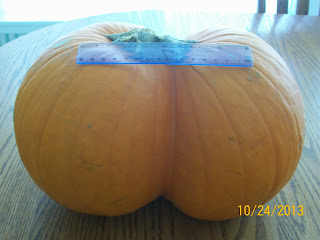
I have three pumpkins that I'd like to submit.
The first one when you look at it from one angle it looks like an ordinary pumpkin

But when you look at it from a different angle you can see that its a conjoined twin.
It reminded me of twinning in some feldspar crystals.

After I took the photo's I realized I would be remiss not to have a scale on it so you can get a sense of how big they were.
 Next one is:
It reminded me of pillow lava.
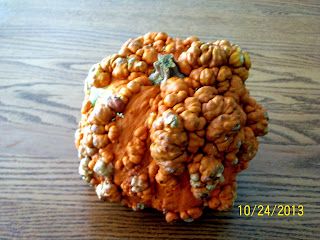 Again
I forgot to use the scale and this didn't quite turen out how I wanted
it to and you can barely see the scale but it is there.
Again
I forgot to use the scale and this didn't quite turen out how I wanted
it to and you can barely see the scale but it is there.
 The last one I wanted to use is this one.
 No scale but the brick are 8x4 inches long.

The call for November Accretionary Wedge is here @ Martin B:
http://blog.martinb.za.net/2013/call-for-posts-accretionary-wedge-geolloween-edition/
Call for posts – Accretionary Wedge, Geollowe’en Edition
{0 Comments}
Comments are open on this post.
I have three pumpkins that I'd like to submit.
The first one when you look at it from one angle it looks like an ordinary pumpkin

But when you look at it from a different angle you can see that its a conjoined twin.
It reminded me of twinning in some feldspar crystals.

After I took the photo's I realized I would be remiss not to have a scale on it so you can get a sense of how big they were.

It reminded me of pillow lava.


Tuesday, October 22, 2013
Accretionary Wedge #61 - What Geocoursework is most helpful in your work
Geo Mika is hosting Accretionary Wedge 61: here's the link: http://www.geomika.com/blog/2013/10/01/61-october-2013-what-do-you-do/.
Here is the call to post:
So, for the October 2013 Accretionary Wedge, tell us: What do you do? What coursework is (or would be) most helpful? How often are you in the field? What does your job look like? How did it or will it change over time (junior to senior positions)? Drop me a link here, or tweet me at @mikamckinnon.
At first I wasn't going to do this AW because right now I'm just a stay at home mom that is retired. If that doesn't make sense to you its because I had a child at the age of 43 (who is now a teenager) and back in 2005 when my husband bought out another business it came with a very efficient office manager and I no longer had to do his books for him. It just made more sense to stay home and take care of my child than to try to find another job. We joked about me being retired since some of my high school friends were starting to retire anyway at that time.
Also shortly after I was no longer working for my husbands business and deciding to go back to work in geology two events happened in my life that made me realize I was no longer cut out to be a geologist, especially one working in the field which is what I loved to do. They also made me think about life and what was really important to me.
The first was I got bit by a fire ant and had an anaphylactic reaction to it. It turns out I'm highly allergic to all ants, not just fire ants. Its kinda hard being outside all the time and not be around ants unless I'm in some remote cold location which just wasn't going to happen living in Louisiana. That was something that I could deal with as long as I continued to get shots and also always carried epi-pens with me. But the other thing stopped me and made me rethink everything and realized I just wasn't suppose to be a working geologist again.
The second thing that happened was I ended up with skin cancer on my face and I'm suppose to avoid direct sunlight on my face as much as possible. As it happened when I used to go out into the field I would not wear sunscreen or very little (mostly because that was before they were aware of how important it was to wear). Its hard working and keeping your face and skin covered in the hot LA sun. Don't make the mistake I did of never wearing sunscreen- if you do work in the field make sure you put plenty sunscreen on.
But being a stay at home mom has its advantages because now I get to help drive to different places where my husband has meetings to attend. While he is doing his business thing I get to play tourist and see and do a lot of different interesting things like going to the petrified forest in MS here , or rockhounding in North Carolina here, or seeing the Austin chalk here , or seeing the boulders weathering in AZ here and there are other places I've been too like Spain and the Alps that were just as much fun and only came about because of business reasons. (Even though I have had these setbacks to keep me from working in geology all the time, you can't keep me away from it totally. I rather be dead than not be able to explore and see different interesting geological features - I just go & see & do and hope nothing bad happens plus I now always carry epi-pens & a cellphone with me where ever I go..)
I did work in the geology field for awhile in the oil and gas industry as a developmental geologist. Then when the downturn came in late 80's/ early 90's I did go into bookkeeping. At the time bookkeeping was good for me since I had small children and could work from my home and my husband started his own business and this kept us from having to hire someone. I ended up doing that for 20 + years.
When I was first in the oil and gas industry I was not married or had children. I never realized how much time I would be spending away from my place. I enjoyed the work and didn't mind but knew having a family would be difficult. Back in 1986 because it was difficult to get a job in geology at that time, I decide it was time to start a family if I was ever going to have one. I've never regretted making that choice but it did keep me away from geology for a long time.
The few women I knew in the industry at that time all had to make that decision- whether it was more important to have a family and work elsewhere or to stay in the field and not have children. Working as an oil & gas geologist and having kids just did not work out because we would spend so much time out on the rigs - In the 1980's I did not know of a single woman that was able to do both. Sooner or later something had to give and usually it was their job. Most of the one's I knew that had kids ended up becoming school teachers. Please keep in mind that when I went into geology it was before fax machines, cellphone, PC and laptop computers were invented. You had to go out to the rig and stay there until the job was done. One time I was on a rig for a month and a half. Times have changed with those inventions and so now I really can't say anything about how things are in the industry and being a working mother.
(The men I knew never had a problem with having children and working in the field. They would let their wives handle the kids while they were gone. Most of the wives did not work or had jobs that were not petroleum related like teaching or office managers. I knew of a couple of couples that were both geologist but they never had children due to health issues of one of the spouses.)
Courses I took that helped me a lot - hydrology and a Oil & Gas exploration course or mineral exploration. I think everyone should have had something along those lines if you don't plan to work in the academic world.
Courses I did not take and wished I had: was anything business related. When you get out into the workforce whether its being a professor or in the industry its all business related and budget driven. Once I started to work my company paid me to take those business courses because they were so important. Since I had some under my belt it made it easy to go into bookkeeping/accounting later on. It's always good to have a plan B that you can fall back upon if things don't work out the way you envision them to.
I would also say if you are a female - consider taking some education courses if you want to have a family too just in case working in the field doesn't work for you. Education courses also would help if you plan on going into academia and getting your PhD. Nothings worse than having a boring teacher and those courses can help you with your teaching aspect of it.
I know I've been out of the field for a long time and things probably have changed but I can't imagine things changing so much that having business courses won't be of a benefit to you.
The other thing is - I feel like I can never learn enough about geology and have enjoyed studying geologic things my whole life- I'm constantly getting new books and field guides. You can never know it all and its something you can spend your whole life perusing and enjoying. The one thing that has changed so much since when I got into it-- was plate tectonics. When I got into the geology field plate tectonics was not in the text books and they have all been revised to incorporate this idea. I wonder what other fascinating discovery is out there that will revise later books. I love coming across something that gives me a whole new perspective on something I had previously studied, like Walter Alverez and his theory of how the dinosaurs died off due to a meteorite crashing into the area that is now Mexico. I can't wait to see what other discoveries that are going to come about and change my thinking about certain things.
This is not related to the post.
I would like to host the Accretionary Wedge some time. If I got December - I would like to do Geo-Ornaments. Make and ornament from a favorite mineral or rock and then post a photo of it. If it was for some other time another Accretionary Wedge I would like to host is - Keep Sake Geology - think of a favorite place that has interesting geology and make a keepsake photo of it - that is representative of the area and captures what makes it so interesting geologically wise.
I've tried submitting these but have never heard back or been scheduled in. I would greatly appreciate any help with this and being able to host again.
Here is the call to post:
So, for the October 2013 Accretionary Wedge, tell us: What do you do? What coursework is (or would be) most helpful? How often are you in the field? What does your job look like? How did it or will it change over time (junior to senior positions)? Drop me a link here, or tweet me at @mikamckinnon.
At first I wasn't going to do this AW because right now I'm just a stay at home mom that is retired. If that doesn't make sense to you its because I had a child at the age of 43 (who is now a teenager) and back in 2005 when my husband bought out another business it came with a very efficient office manager and I no longer had to do his books for him. It just made more sense to stay home and take care of my child than to try to find another job. We joked about me being retired since some of my high school friends were starting to retire anyway at that time.
Also shortly after I was no longer working for my husbands business and deciding to go back to work in geology two events happened in my life that made me realize I was no longer cut out to be a geologist, especially one working in the field which is what I loved to do. They also made me think about life and what was really important to me.
The first was I got bit by a fire ant and had an anaphylactic reaction to it. It turns out I'm highly allergic to all ants, not just fire ants. Its kinda hard being outside all the time and not be around ants unless I'm in some remote cold location which just wasn't going to happen living in Louisiana. That was something that I could deal with as long as I continued to get shots and also always carried epi-pens with me. But the other thing stopped me and made me rethink everything and realized I just wasn't suppose to be a working geologist again.
The second thing that happened was I ended up with skin cancer on my face and I'm suppose to avoid direct sunlight on my face as much as possible. As it happened when I used to go out into the field I would not wear sunscreen or very little (mostly because that was before they were aware of how important it was to wear). Its hard working and keeping your face and skin covered in the hot LA sun. Don't make the mistake I did of never wearing sunscreen- if you do work in the field make sure you put plenty sunscreen on.
But being a stay at home mom has its advantages because now I get to help drive to different places where my husband has meetings to attend. While he is doing his business thing I get to play tourist and see and do a lot of different interesting things like going to the petrified forest in MS here , or rockhounding in North Carolina here, or seeing the Austin chalk here , or seeing the boulders weathering in AZ here and there are other places I've been too like Spain and the Alps that were just as much fun and only came about because of business reasons. (Even though I have had these setbacks to keep me from working in geology all the time, you can't keep me away from it totally. I rather be dead than not be able to explore and see different interesting geological features - I just go & see & do and hope nothing bad happens plus I now always carry epi-pens & a cellphone with me where ever I go..)
I did work in the geology field for awhile in the oil and gas industry as a developmental geologist. Then when the downturn came in late 80's/ early 90's I did go into bookkeeping. At the time bookkeeping was good for me since I had small children and could work from my home and my husband started his own business and this kept us from having to hire someone. I ended up doing that for 20 + years.
When I was first in the oil and gas industry I was not married or had children. I never realized how much time I would be spending away from my place. I enjoyed the work and didn't mind but knew having a family would be difficult. Back in 1986 because it was difficult to get a job in geology at that time, I decide it was time to start a family if I was ever going to have one. I've never regretted making that choice but it did keep me away from geology for a long time.
The few women I knew in the industry at that time all had to make that decision- whether it was more important to have a family and work elsewhere or to stay in the field and not have children. Working as an oil & gas geologist and having kids just did not work out because we would spend so much time out on the rigs - In the 1980's I did not know of a single woman that was able to do both. Sooner or later something had to give and usually it was their job. Most of the one's I knew that had kids ended up becoming school teachers. Please keep in mind that when I went into geology it was before fax machines, cellphone, PC and laptop computers were invented. You had to go out to the rig and stay there until the job was done. One time I was on a rig for a month and a half. Times have changed with those inventions and so now I really can't say anything about how things are in the industry and being a working mother.
(The men I knew never had a problem with having children and working in the field. They would let their wives handle the kids while they were gone. Most of the wives did not work or had jobs that were not petroleum related like teaching or office managers. I knew of a couple of couples that were both geologist but they never had children due to health issues of one of the spouses.)
Courses I took that helped me a lot - hydrology and a Oil & Gas exploration course or mineral exploration. I think everyone should have had something along those lines if you don't plan to work in the academic world.
Courses I did not take and wished I had: was anything business related. When you get out into the workforce whether its being a professor or in the industry its all business related and budget driven. Once I started to work my company paid me to take those business courses because they were so important. Since I had some under my belt it made it easy to go into bookkeeping/accounting later on. It's always good to have a plan B that you can fall back upon if things don't work out the way you envision them to.
I would also say if you are a female - consider taking some education courses if you want to have a family too just in case working in the field doesn't work for you. Education courses also would help if you plan on going into academia and getting your PhD. Nothings worse than having a boring teacher and those courses can help you with your teaching aspect of it.
I know I've been out of the field for a long time and things probably have changed but I can't imagine things changing so much that having business courses won't be of a benefit to you.
The other thing is - I feel like I can never learn enough about geology and have enjoyed studying geologic things my whole life- I'm constantly getting new books and field guides. You can never know it all and its something you can spend your whole life perusing and enjoying. The one thing that has changed so much since when I got into it-- was plate tectonics. When I got into the geology field plate tectonics was not in the text books and they have all been revised to incorporate this idea. I wonder what other fascinating discovery is out there that will revise later books. I love coming across something that gives me a whole new perspective on something I had previously studied, like Walter Alverez and his theory of how the dinosaurs died off due to a meteorite crashing into the area that is now Mexico. I can't wait to see what other discoveries that are going to come about and change my thinking about certain things.
This is not related to the post.
I would like to host the Accretionary Wedge some time. If I got December - I would like to do Geo-Ornaments. Make and ornament from a favorite mineral or rock and then post a photo of it. If it was for some other time another Accretionary Wedge I would like to host is - Keep Sake Geology - think of a favorite place that has interesting geology and make a keepsake photo of it - that is representative of the area and captures what makes it so interesting geologically wise.
I've tried submitting these but have never heard back or been scheduled in. I would greatly appreciate any help with this and being able to host again.
Thursday, September 26, 2013
Accretinary Wedge #60 - Momentous Discoveries in Geology
Matt Herod is hosting the next accrectionary wedge #60 ( here's the link) And here's the actual call
"There are lots of sayings out there about how science is a journey with many steps and paths or a giant building made of many small blocks that contribute to the enormity of an entire field. All of these cliches are pretty much pointing out the same thing. Namely, that the knowledge base in each field is composed of the work of thousands of people all contributing a little bit and slowly building an understanding of the natural world. This is very true, however, some of these contributions are bigger than others, and geology is no exception. Over the history of geology there have been many major discoveries that advanced the science, from the original work of Hutton, Lyell, Steno and Darwin, to more modern revelations. Each discovery has in some way altered our perception of how the Earth works and either opened new avenues of research or provided previously unknown constraints and laws. Therefore, for this wedge the topic will be momentous discoveries in geology or its sub-disciplines that you feel have altered or shaped our understanding of how the Earth works, or opened new doors into research that had never been considered before. The discovery you choose does not have to be universally recognized as momentous but should be in your opinion"
I've been out of Geology for awhile and was tempted to skip this one but then I thought about a book that I've recently read - well actually its two different books but were by the same author: Walter Alvarez. And when I first read them they really made an impact on me because it really got me rethinking things and feeling like his research made a lot of sense to me and I might have to change my opinion on how the dinosaurs died off.
The Walter Alvarez first book is 'T-Rex and the Crater of Doom' (1997 but now available on kindle) and the other is 'The Mountains of Saint Francis' (2009 also available on Kindle). What I really liked about these books was the way he wrote them so that a lay person could read them and follow his reasoning. He was interested in the K/T Cretaceous Tertiary boundary and how plate tectonics could be applied to it in Italy. (Plate tectonics is another topic I was tempted to write about because when I was in school -mid 70's it was just coming out and there was a lot of controversy over it - but at the time it was not in my textbooks and not always taught.Now all the textbooks are rewritten applying that theory) I guess that was why I was reading the book The Mountains of Saint Francis since Alvarez was such a major force in getting plate tectonics widely accepted. But that was not what this post is going to be about.
What I really liked was the way he proposed a major meteorite hit the earth and that caused the extinction of the dinosaurs. The impact site was Chicxulub Crater. Here's the link to Wikipedia about Walter_Alvarez and here's an article about the K/T_extinction_event that tells about it better than I can. What I really like was in the books Alvarez tells about how the theories evolved and were constantly revised based on new research. Now I feel geologist have to think about asteroids as a possible explanation for mass extinctions that have occurred in the past. What really got me thinking was I'm used to thinking that geologic events happen over millions and millions of years but as Alvarez pointed when a meteorite hits its basically instantaneous and so not all geologic processes happen over time - some can be quite rapid. Making me have to change the way I think about things to me makes it a momentous discovery and that was why I would like for it to be include in AW#60.
The Accretionary Wedge #60 – Call for Posts – Momentous Discoveries in Geology
"There are lots of sayings out there about how science is a journey with many steps and paths or a giant building made of many small blocks that contribute to the enormity of an entire field. All of these cliches are pretty much pointing out the same thing. Namely, that the knowledge base in each field is composed of the work of thousands of people all contributing a little bit and slowly building an understanding of the natural world. This is very true, however, some of these contributions are bigger than others, and geology is no exception. Over the history of geology there have been many major discoveries that advanced the science, from the original work of Hutton, Lyell, Steno and Darwin, to more modern revelations. Each discovery has in some way altered our perception of how the Earth works and either opened new avenues of research or provided previously unknown constraints and laws. Therefore, for this wedge the topic will be momentous discoveries in geology or its sub-disciplines that you feel have altered or shaped our understanding of how the Earth works, or opened new doors into research that had never been considered before. The discovery you choose does not have to be universally recognized as momentous but should be in your opinion"
I've been out of Geology for awhile and was tempted to skip this one but then I thought about a book that I've recently read - well actually its two different books but were by the same author: Walter Alvarez. And when I first read them they really made an impact on me because it really got me rethinking things and feeling like his research made a lot of sense to me and I might have to change my opinion on how the dinosaurs died off.
The Walter Alvarez first book is 'T-Rex and the Crater of Doom' (1997 but now available on kindle) and the other is 'The Mountains of Saint Francis' (2009 also available on Kindle). What I really liked about these books was the way he wrote them so that a lay person could read them and follow his reasoning. He was interested in the K/T Cretaceous Tertiary boundary and how plate tectonics could be applied to it in Italy. (Plate tectonics is another topic I was tempted to write about because when I was in school -mid 70's it was just coming out and there was a lot of controversy over it - but at the time it was not in my textbooks and not always taught.Now all the textbooks are rewritten applying that theory) I guess that was why I was reading the book The Mountains of Saint Francis since Alvarez was such a major force in getting plate tectonics widely accepted. But that was not what this post is going to be about.
What I really liked was the way he proposed a major meteorite hit the earth and that caused the extinction of the dinosaurs. The impact site was Chicxulub Crater. Here's the link to Wikipedia about Walter_Alvarez and here's an article about the K/T_extinction_event that tells about it better than I can. What I really like was in the books Alvarez tells about how the theories evolved and were constantly revised based on new research. Now I feel geologist have to think about asteroids as a possible explanation for mass extinctions that have occurred in the past. What really got me thinking was I'm used to thinking that geologic events happen over millions and millions of years but as Alvarez pointed when a meteorite hits its basically instantaneous and so not all geologic processes happen over time - some can be quite rapid. Making me have to change the way I think about things to me makes it a momentous discovery and that was why I would like for it to be include in AW#60.
Thursday, August 29, 2013
Accretinary Wedge #59 What Geo field guides do you recomend
Mika over at GeoMika
has put out the Accretionary wedge #59 call for post ( here )
And here is the actual call she put out:
The Accretionary Wedge is an ongoing geoblogosphere carnival, a month of thematic posts on any topic that strikes the collective fancy. After watching geotweeps compliment a particular field guide, I ask: what do you think of the field guides for your region? Do you use USGS books, part of the “Roadside Geology of…” series, conference proceedings, a homegrown booklet produced by your local college, or something entirely different?
To get things started, I have a few archive posts on Vancouver field-trips for AAAS attendees, and a book review of Vancouver: City on the Edge.
Submissions are due by September 1: just post a link in the comments or via Twitter (@mikamckinnon). I’ll post a list of all the reviews, for future advice when picking books to guide our rock-seeking travels.
I've been out of geology for a long long time, and because of that I've lost a lot of my networking contacts especially ones connected to the Universities in the area I live so I didn't have access to their guides. Another big factor was I did not get my geology degrees in the area - I had to rely on other sources to get my field guides for the area I lived in. Usually it was through some field trip connected with a seminar that I had to pay money for and the guides were copy-write protected and mostly dealt with the oil and gas industry and were not in the public domain. Since I stopped working in the oil and gas industry 20 years ago my ability to go to those seminars also came to a standstill and thus my access to those types of guides--- so all that left me with is the Roadside Geology of ..... series.
I live in the Ark-LA-Tex area. As far as I know there is no Roadside Geology of Arkansas available. I have come across a couple of rock and crystal/ gem collecting books for Arkansas but they are area specific and the the geology is not very strong. Nothing I would like to recommend. The state has a lot to offer and its been a big disappointment to me that there isn't anything better to go by. If anyone knows of anything that I've missed please leave a comment.
I do have the Roadside Geology of Louisiana by Darwin Spearing (2nd ed -2007) - it's been awhile since I've looked at it so I could be wrong but when I got done with it I was hoping there would be more to it.. It could simply be the nature of the state - the land just spreading outward into the gulf coast over millions and millions of years. At least it was better than nothing and it did give you a starting point to look into some other areas of interest because it does have an extensive reference list. And it's a whole lot better than when I got here and there was nothing like that around to go by and look at. I do like the way he wrote it so most non geologist type people could understand it.
Through that book I've come across some geologic maps and stuff that was put out by the geology dept of LSU in Baton Rouge and also the AAPG (American Association of Petroleum Geologist)- their Geologic Highway Map of the Southeastern Region. I have found those to be helpful too.
But I must admit that when I go to an area I don't like to do too much research at first, so I can look at an area and figure things out for myself. Then after I get home that's when I like to start to do the research to see if what is out there is in agreement with what I was seeing and observing.
The one guide that I just love is the Roadside Geology of Texas by Darwin Spearing (1991). I have found this to be an extremely helpful book and have looked at it often after I have gotten back from Texas. But I must admit I have not used it for the western part of the state and am not too sure how it is for that region. Again I like the way Spearing writes for the non geologist so anyone can pick it up and read it and get an idea of what is going on geologically in the region that they are in. Texas is a big state and it has just about anything you can imagine geologically (except glaciers) in it. There is a lot of material to be covered and I know Spearing couldn't cover it all but does a good job with exposing you to most of it without getting too technical about it at the same time. One of the things about Texas-- there is more geologist living in that state than anywhere else in the world so the state has been studied more extensively than anywhere else in the world too due to the Oil and Gas industry and all of the money associated with oil and gas exploration. Also because of the O&G industry its subsurface has been extensively mapped too, giving some incites into some regions that may not be apparent from just surface outcrops, especially when it came to the faulting in the coastal regions. Like the Louisiana book it does have a good reference section. It also tells you how to reach some regional geologic societies to get their guide books for specific areas of interest.
has put out the Accretionary wedge #59 call for post ( here )
And here is the actual call she put out:
August Accretionary Wedge
The Accretionary Wedge is an ongoing geoblogosphere carnival, a month of thematic posts on any topic that strikes the collective fancy. After watching geotweeps compliment a particular field guide, I ask: what do you think of the field guides for your region? Do you use USGS books, part of the “Roadside Geology of…” series, conference proceedings, a homegrown booklet produced by your local college, or something entirely different?
To get things started, I have a few archive posts on Vancouver field-trips for AAAS attendees, and a book review of Vancouver: City on the Edge.
Submissions are due by September 1: just post a link in the comments or via Twitter (@mikamckinnon). I’ll post a list of all the reviews, for future advice when picking books to guide our rock-seeking travels.
I've been out of geology for a long long time, and because of that I've lost a lot of my networking contacts especially ones connected to the Universities in the area I live so I didn't have access to their guides. Another big factor was I did not get my geology degrees in the area - I had to rely on other sources to get my field guides for the area I lived in. Usually it was through some field trip connected with a seminar that I had to pay money for and the guides were copy-write protected and mostly dealt with the oil and gas industry and were not in the public domain. Since I stopped working in the oil and gas industry 20 years ago my ability to go to those seminars also came to a standstill and thus my access to those types of guides--- so all that left me with is the Roadside Geology of ..... series.
I live in the Ark-LA-Tex area. As far as I know there is no Roadside Geology of Arkansas available. I have come across a couple of rock and crystal/ gem collecting books for Arkansas but they are area specific and the the geology is not very strong. Nothing I would like to recommend. The state has a lot to offer and its been a big disappointment to me that there isn't anything better to go by. If anyone knows of anything that I've missed please leave a comment.
I do have the Roadside Geology of Louisiana by Darwin Spearing (2nd ed -2007) - it's been awhile since I've looked at it so I could be wrong but when I got done with it I was hoping there would be more to it.. It could simply be the nature of the state - the land just spreading outward into the gulf coast over millions and millions of years. At least it was better than nothing and it did give you a starting point to look into some other areas of interest because it does have an extensive reference list. And it's a whole lot better than when I got here and there was nothing like that around to go by and look at. I do like the way he wrote it so most non geologist type people could understand it.
Through that book I've come across some geologic maps and stuff that was put out by the geology dept of LSU in Baton Rouge and also the AAPG (American Association of Petroleum Geologist)- their Geologic Highway Map of the Southeastern Region. I have found those to be helpful too.
But I must admit that when I go to an area I don't like to do too much research at first, so I can look at an area and figure things out for myself. Then after I get home that's when I like to start to do the research to see if what is out there is in agreement with what I was seeing and observing.
The one guide that I just love is the Roadside Geology of Texas by Darwin Spearing (1991). I have found this to be an extremely helpful book and have looked at it often after I have gotten back from Texas. But I must admit I have not used it for the western part of the state and am not too sure how it is for that region. Again I like the way Spearing writes for the non geologist so anyone can pick it up and read it and get an idea of what is going on geologically in the region that they are in. Texas is a big state and it has just about anything you can imagine geologically (except glaciers) in it. There is a lot of material to be covered and I know Spearing couldn't cover it all but does a good job with exposing you to most of it without getting too technical about it at the same time. One of the things about Texas-- there is more geologist living in that state than anywhere else in the world so the state has been studied more extensively than anywhere else in the world too due to the Oil and Gas industry and all of the money associated with oil and gas exploration. Also because of the O&G industry its subsurface has been extensively mapped too, giving some incites into some regions that may not be apparent from just surface outcrops, especially when it came to the faulting in the coastal regions. Like the Louisiana book it does have a good reference section. It also tells you how to reach some regional geologic societies to get their guide books for specific areas of interest.
Subscribe to:
Posts (Atom)